Showing posts with label Amateur Radio. Show all posts

Saturday, November 15, 2008

Ham terms...

So I just realized, I have been using some terms that some of you may not be familiar with. So I guess I will list as many as I can, to give you a better understanding of what I am saying.
  • 73: best regards, usually used at the end of a conversation.
  • MARS/CAP: Military Affiliate Radio System/Civilian Air Patrol
  • Mod: Modify, usually used when talking about modifying a radio. Also Modulate/Modulation, which is basically making a radio emission that contains information.
  • Mobile: A Ham that is moving while transmitting. Or a mobile radio which is one that is used in an automotive, runs off of 12V.
  • Mic: Microphone, converts sound waves to electrical signal
  • Call Sign: The FCC license that is given to every amateur radio operator that passes their exam. Calls signs generally are in a few different formats, for simplicities sake I will say that it begins with a letter has a number and ends with a letter. Such as XX6XXX. The number of letters will vary.
  • CW: Morse Code, also Continuous Wave which is an unmodulated signal. Mainly it will refer to Morse Code, which oddly enough is an interrupted wave.
  • Cross Band: Transmitting on one band, and receiving on another. Usually used when you are mobile, more on this later.
  • CTCSS: Short for Continuous Tone-Controlled Squelch System. basically subaudible tones that, usually, activate a repeater, another radio, or some other device.
  • DTMF: Dual Tone Multi Frequency, Which are commonly known as touch tones. Sent via a touch pad on the transceiver, also used for controlling or activating devices.
  • DCS: Digital Code Squelch/Disaster Communications. used for controlling devices, like CTCSS, except digital uses a code with a 23-bit frame transmitted at 134.4 bps (bits/secs) basically a subaudible tone.
  • DB: It is a unit to measure the ratio of two power measurements. usualy used in conjunction with Gain, to indicate the amount of power gain an antenna gives you.
  • Wavelength: The length of any given radio wave.
  • Band: Aerosmith, Def Leppard, Boston, you know band. Just kidding, the band, such as 2 meters, is where a certain frequency is located. The 2m band is called that because of the physical wavelength of the signal being emitted.
  • Frequency: Often abbreviated as "Freq," this is the measure of the oscillation of a given radio wave. Frequency is measured in Hertz which is cycles per second.
  • MHz/KHz/Hz: Megahertz, Kilohertz, and Hertz. Megahertz is a million Hertz, Kilohertz is a thousand Hertz.
  • Duplex/Dual receive: Duplex is where a radio transmits on one freq and receives on another the difference in freqs is determined by the radio's step (see Step). Dual receive is where a radio receives, or listens to, two freqs a once.
  • Simplex: Single freq transmitting, where the radio transmits and receives on one freq only.
  • Repeater: A device that receives one freq, and retransmits what it receives on another freq.
  • Step: Step refers to the Step, like walking forward, that a radio takes to advance the freq that it is monitoring. This is measured in Hz, such as 5, 10, 12.5, 20, 40, 100 KHz steps. The Ham freqs, usually, take 20 KHz, where as FRS/GMRS take 12.5 KHz
That is all for now, I can't think of any more that I will use, but if I do use some terminology that you don't understand you can always google "Ham radio terms" this will bring a few sites that will contain the needed information.

73!

Friday, November 14, 2008

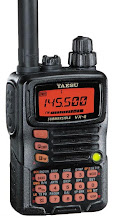
VX-6r a great radio!


In amateur radio you have a few different users.
  • Commercial radio users
  • Amateur radio users
  • Homebrew radio users
These all have their different pros and cons. Some people favor Commercial radios versus Amateur radios. In my opinion Amateur radios are my first choice, because they have lots of different tools built in.

For instance take the VX-6r a tri-band handheld, 144 MHz, 430 MHz, 222 MHz. The first two bands are the most popular VHF/UHF Amateur bands in Southern California. This radio has tons of different features that I enjoy having. Many of them are listed Here which shows full specs and features for the VX-6.

Some, but not all, options are as follows:
  • Mic gain control
  • Password protected
  • Submersible for up to 3ft for 30 mins
  • 24 memory banks
  • Memory bank continuous scanning
  • CW training feature
  • Very bright white LED light
And the list goes on... There are a ton of features, and they are all handy. you can also preform a mod on this radio to open up full TX ability. Warning: If you do this mod, ONLY TX on 6m, 2m, 220 MHz, 70cm, and FRS/GMRS Freqs. No other bands, you will mess up your radio, it is only made for these freqs. The mod is certified by Yaesu as a MARS/CAP mod. Warning: As all Hams know only transmit on freqs that you are licensed for.

Commercial radios are very good as well. They have excellent audio quality, they are built sturdily, strong signals, and they are cheap. The only problem I have with Commercial radios are thus:
  • A lot are limited to certain "channels" or memory presets. If you want to go to 446.400 MHz and it is not programmed into you radio's channel then there is no way to get there, without hooking the radio up to a computer and programing in that frequency.
  • Many do not have display screens.
  • Because there is no display screen you must memorize which freq is in any given channel.
  • You can not change the power level without hooking the radio up to a computer and programing the power level for that frequency on a certain channel.
  • Many have an MDC or equivalent tone burst at the beginning or end of every transmission, this can get annoying, it can be turned off, but only if you hook it up to a computer.
Now of course this does not pertain to all commercial radios. I have seen some with screens, and I have seen some with a free frequency navigation, but not many. They are great if you are not going to be moving around much, and conditions are fairly stable in your area. Also if you use only a few frequencies, then they are great radios. They are heavy and solid, they can take abuse, and they are cheap!

Homebrew radios are another world. You can customize, program, and make them the way you want to. They tend to be larger, and more simple than Amateur radios, and Commercial radios. They are made by the Ham so they are what you want them to be, but you have to have a lot of technical experience, and you must own a lot of equipment, some of it fairly expensive.

In the end it all depends on the Ham who is looking for the radio. They are all great radios, it just depends upon your tastes.

73!